Overview
HIE provides the capability to electronically move clinical information among disparate health care information systems while maintaining the meaning of the information being exchanged. The goal of HIE is to facilitate access to and retrieval of clinical data to provide safer and more timely, efficient, effective, and equitable patient-centered care. HIE is also useful to public health authorities to assist in analyses of the health of the population.
HIE systems facilitate the efforts of physicians and clinicians to meet high
standards of patient care through electronic participation in a patient's
continuity of care with multiple providers. Secondary health care provider
benefits include reduced expenses associated with:
- the manual printing, scanning and faxing of documents, including paper and ink costs, as well as the maintenance of associated office machinery
- the physical mailing of patient charts and records, and phone communication to verify delivery of traditional communications, referrals, and test results
- the time and effort involved in recovering missing patient information, including any duplicate tests required to recover such information
Healthcare Networks (HCNs), also known as Healthcare Information Networks (HINs), are becoming important because they enable the exchange of healthcare messages and documents and support electronic collaboration among healthcare entities. As shown in Figure 1, the participants in HCNs include healthcare providers (hospitals, clinics, physicians, public health providers, specialists), public health agencies (local, regional and national), patients, payers (government or private insurers), medical laboratories, pharmacies, pharmaceutical and medical device manufacturers, and researchers.
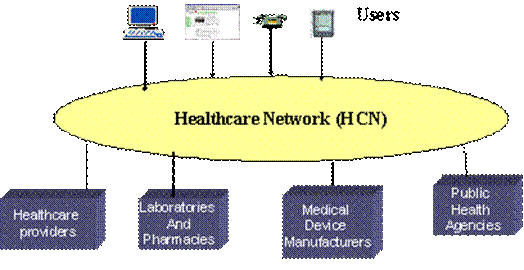
Figure 1: Conceptual View of a Healthcare Network (HCN)
The term Health Information Network is sometime used as a social network and not as a technical network. The term National Health Information Network (NHIN) is used for a technical network of health networks that will allow patients and providers to access clinical data using standard technologies. HINs can also be hybrid, where health information is delivered to a patient using a mixture of social and technical networks.