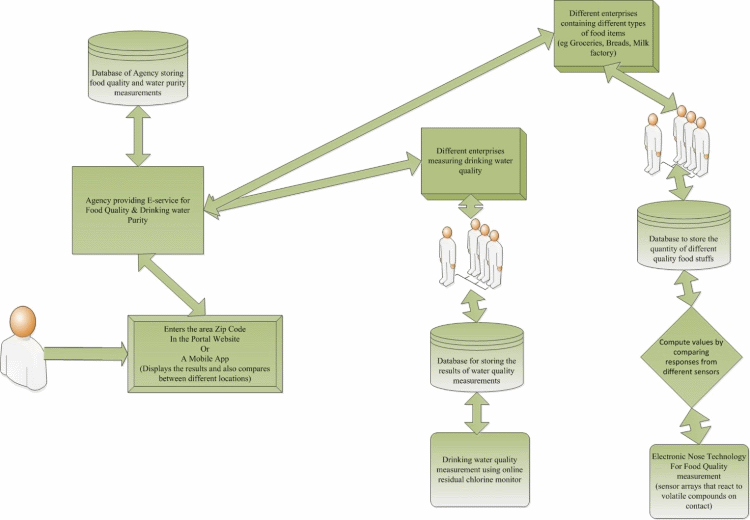
Figure: Food quality and water purity e-service architecture
This architecture is very simple and should be implemented in each city or a country or a region having about 1 million people. Food and water are the main resources in the life cycle of a person and is very important that it is of good quality before intake of both food and water. Hence monitoring the quality by different measures is of importance by conducting a survey or by electronic means, i.e. according to the e-service architecture definition.
This e-service architecture defines two different electronic measurement techniques that most of the enterprises perform viz: Online residual chlorine monitor that determine PPM of chlorine and classify water quality according to it and another is the Electronic nose technology for defining the food quality that classifies food quality according to odor, flavor etc. These measured content are electronically stored in different tables so that they can be retrieved by any agency to act on these measured values. These values are also generally used as a point of survey and compare these results obtained in different areas.
Different enterprises retrieve the e-content by directly querying the database and is distributed to different agencies. Such a typical agency works on the content from various enterprises that do quality measurement like purity of drinking water and food quality of different types of food stuffs available abundantly in that area. In a city like Philadelphia, the agency then maintains a database of itself that holds the values combined from both the public safety services and is retrieved using a front-end button that acts as the interface between the user and the network.
The key components of this e-service architecture are:
5. Logical Model
This logical architecture shows the various ways information is measured, retrieved and even added and distributed among different enterprises. The e-content are also used by other e-services in the public safety sector as these services are somehow related to other e-services defined in the sector. The performance or the reasons for quality depends upon other e-services like the weather forecast which may change the quality measurement values of different food stuffs present currently.
